

Tattoos Under Sedation or General Anaesthesia: The Real Risks (Bali, Perth and Australia)
Videos of people waking up from a general anaesthetic with a finished back piece or body suit are being shared widely, and more Australians are asking us about “sleep tattoos”, especially after recent news stories about Australians travelling to Bali to be tattooed while unconscious. Our view is simple: we do not recommend it. A tattoo is an elective, cosmetic procedure, and putting someone under a general anaesthetic just so they can skip the discomfort adds real medical risk for no medical benefit. Here is what doctors, anaesthesia specialists and health authorities say, whether you live in Perth, regional Western Australia, Sydney, Melbourne or anywhere else in Australia.
Australian doctors are warning against it
In late October 2026, Nine News reported that Australian doctors were concerned about a growing number of Australians being tattooed under general anaesthetic in Bali, with several artists working on one person at the same time. A spokesperson for the Australian Medical Association told Nine: “An anaesthetic just for convenience is a dangerous proposition.”
Earlier, the president of the Australian and New Zealand College of Anaesthetists (ANZCA) told Yahoo News Australia that all general anaesthesia carries a degree of risk, that a facility must have the right equipment and enough staff if something goes wrong, and that overseas qualifications, hospital accreditation and equipment may not consistently meet Australian standards for hygiene and safety.
A death before the first line was drawn
In January 2025, a 45-year-old Brazilian businessman died after going under general anaesthesia for a back tattoo at a day hospital in southern Brazil. According to reports in E! News, the Daily Mail and Brazilian media, the tattoo studio said he went into cardiac arrest at the start of sedation and intubation, before any tattooing had begun. Brazilian outlets later reported that his death certificate linked the arrest to the anaesthetic induction and to past anabolic steroid use, which his family disputed, and police investigated.
In July 2025, Brazil’s Federal Council of Medicine banned sedation, general anaesthesia and nerve blocks for tattooing, with narrow exceptions for medical reconstructive work in proper health facilities, according to Brazilian news reports. One reason given was that non-medical tattoo settings do not meet the requirements for safe anaesthesia.
What anaesthesia specialists say
In June 2025 the American Society of Anesthesiologists (ASA) issued patient guidance on anaesthesia for tattoos. It says the procedure should meet the same safety standards as any elective surgery:
- The anaesthetic must be given by a qualified anaesthesia professional in a facility equipped for monitoring and emergencies. The ASA’s president said plainly that “a tattoo artist’s studio is not a medically appropriate setting for anesthesia.”
- You need a full pre-anaesthetic assessment, may need extra tests, and must be told the risks.
- Lying still for many hours raises the risk of bruising and nerve or soft-tissue injury, so the patient has to be repositioned and watched throughout.
- You need fasting, a recovery plan and someone to get you home safely.
Longer under anaesthetic, higher risk of clots
A large study published in JAMA Surgery in 2014, covering more than 1.4 million surgical patients under general anaesthesia, found that longer operations were linked with a higher risk of blood clots in the legs and lungs (venous thromboembolism). For several common operations, each extra hour raised the risk by around 18 to 26 percent. Sessions under anaesthetic for tattooing are typically marketed as a full day.
A huge fresh tattoo is a huge open wound
A fresh tattoo is an open wound. Covering a back, a body suit or several limbs in one sitting, with several artists working at once, creates a very large area of broken skin all at the same time. Your body then has to heal all of it together: swelling, weeping, pain and a much bigger area that can become infected. In a hot, humid climate, with sun, sweat, sea and pool water close by, that is even harder.
There are other problems too:
- You can’t give feedback. Awake, you can say if something feels wrong, if you feel faint, or if you want to stop. Unconscious, you can’t.
- You can’t take breaks. Breaks let you eat, drink and rest, and let your body recover between sessions.
- Your body is meant to adapt gradually. A 2016 study in the American Journal of Human Biology (Lynn and colleagues) found that people with more tattoo experience showed a different immune response after a session, suggesting the body gets used to tattooing over time. Doing everything at once skips that.
Infection: the risk that follows you home
Infection is one of the most serious risks of any tattoo done without strict hygiene, at home or overseas.
- Golden staph and other bacteria. Cleveland Clinic lists Staphylococcus aureus (golden staph), Streptococcus, Pseudomonas and nontuberculous mycobacteria among the bacteria found in contaminated tattoo ink or non-sterile water, and warns that severe tattoo infections can lead to sepsis, heart infection and organ failure.
- Drug-resistant staph (MRSA). The US Centers for Disease Control and Prevention (CDC) investigated six clusters of MRSA skin infections linked to unlicensed tattooists in 2004–2005: 44 people were infected, 20 needed surgical drainage and four were hospitalised with blood infections.
- Contaminated ink. In 2012 the CDC reported clusters of Mycobacterium chelonae skin infections in four US states, traced to contaminated tattoo ink or ink diluted with non-sterile water.
- Bloodborne viruses from Bali. In January 2012, WA Health reported that a traveller who returned to Western Australia and tested positive for HIV had most likely been infected through a tattoo in Bali, and advised Australians who had recently been tattooed or pierced in Bali to have an HIV blood test.
- Holiday infections elsewhere. British media have reported that a woman spent four days in hospital on intravenous antibiotics with cellulitis after a holiday tattoo in Turkey, and was warned she might lose her foot.
The Australian Government’s Smartraveller service advises travellers to choose tattoo, piercing and medical providers that properly sterilise their tools and surfaces, and to ask for proof before any treatment starts.
What people are saying on social media
The warnings are not only coming from medical bodies. On TikTok, a US anaesthesiologist with a large following reacted to a viral clip of a sleeping tattoo client by telling viewers to “STOP having general anesthesia for tattoos – that’s not what it’s for”, pointing out that the man’s airway was not secured and that drugs building up over a long session can stop a person breathing (reported by VICE, March 2025). Even some Australians interviewed by Nine News in Bali were uneasy; one said it “seems like a lot on the body to have that much tattooed and to heal all at once.”
As tattoo artists, we agree. Good tattooing depends on the client being awake: on feedback, breaks, and healing one section before the next. Speed is not a reason to take a medical risk.
Our advice
If you are thinking about a tattoo under sedation or general anaesthesia, in Bali, overseas or in Australia, please speak to your GP first and ask them to explain the risks for you personally. If you already have a large tattoo from a trip and are worried about how it is healing, see a doctor straight away if you notice spreading redness, increasing pain, pus, fever or chills.
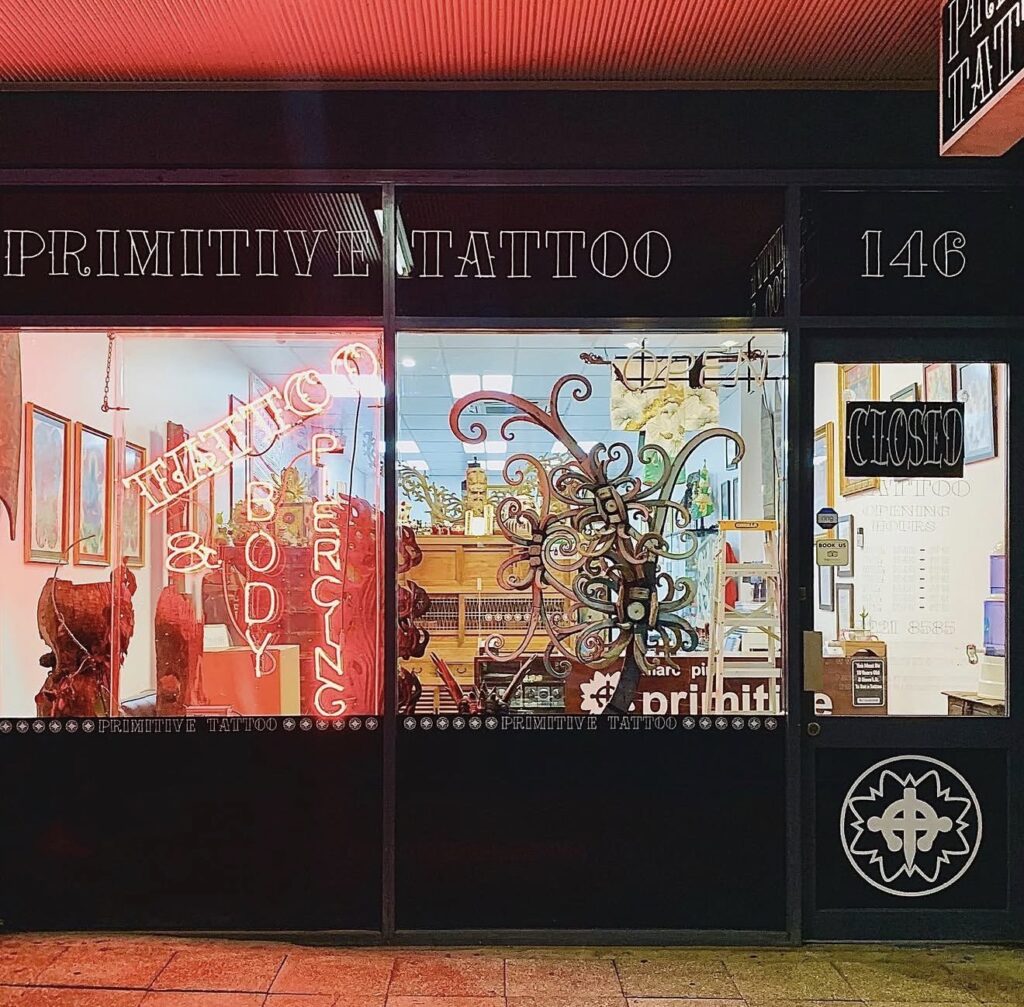
At Primitive Tattoo on Barrack Street in Perth we tattoo large pieces the traditional way: awake, planned properly and in sessions spaced so your skin can heal. If you want to talk through a large piece safely, see our Japanese tattoo work, our sleeve and back piece planning guide, or book a consultation.
This article is general information, not medical advice. Speak to your doctor before any procedure involving sedation or anaesthesia, and see a doctor promptly if you think a tattoo is infected.
Sources
- Nine News, reported by 1News (NZ), “Doctors warn against ‘pain free’ full-body Bali tattoo trend”, 28 October 2026
- VICE, “Anesthesia makes tattoos painless, but it’s probably not a good idea”, 19 March 2025
- Yahoo News Australia, quoted by 91.1 Hot FM, comments from the president of ANZCA, September 2026
- American Society of Anesthesiologists, “Patient Guidance on Anesthesia Care for Tattoo Procedures” and news release, June 2025
- E! News and Daily Mail, January 2025; Bahia Notícias (citing g1), 22 January 2025
- O Povo (Brazil), “Conselho Federal de Medicina proíbe uso de anestesia para fazer tatuagem”, 28 July 2025
- Kim JYS, Khavanin N, et al., “Surgical duration and risk of venous thromboembolism”, JAMA Surgery, 2014 (Northwestern University summary)
- Lynn CD, Dominguez JT, DeCaro JA, “Tattooing to ‘toughen up'”, American Journal of Human Biology, 2016
- Cleveland Clinic, “Tattoo infection”
- CDC, MMWR, “Methicillin-resistant Staphylococcus aureus skin infections among tattoo recipients”, 23 June 2006
- CDC, MMWR, “Tattoo-associated nontuberculous mycobacterial skin infections, multiple states, 2011–2012”, 22 August 2012
- WA Health warning reported by Travel Daily, 5 January 2012
- Grimsby Telegraph (Reach plc), holiday tattoo infection report
- Smartraveller (Australian Government), health advice for travellers